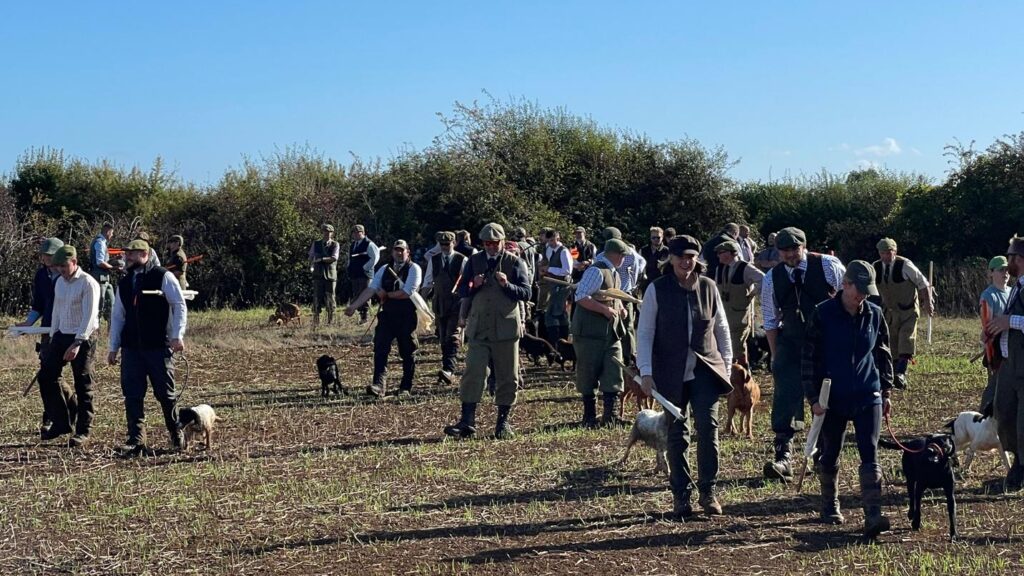
Ponsonby Farms: a day beating for wild grey partridge
BASC’s Sam Walker joins the beaters at Ponsonby Farms in Gloucestershire to see a wild grey partridge recovery, built on shoot management, in action.


Get information on the legal shooting season for mammals and birds in the UK.

Apply for funding for your project or make a donation today

Comprehensive information and advice from our specialist firearms team.

Everything you need to know about shotgun, rifle and airgun ammunition.


Find our up-to-date information, advice and links to government resources.

Everything you need to know on firearms law and licensing.

All the latest news and advice on general licences and how they affect you.


What does climate change mean for the future of wildfowling? BASC’s head of science Dr Cat McNicol considers how climate change is altering bird migration and distribution – and what those changes could mean for wildfowling, conservation and sustainable harvest management.
Climate change is often discussed in terms of rising temperatures or extreme weather, but for those who spend time wildfowling on wetlands, estuaries and reservoirs another story is becoming increasingly apparent. Birds are changing too.
The British Trust for Ornithology’s (BTO) recent report, Climate Change and the UK’s Birds, paints a picture of species responding to climate change in different ways. Some are arriving in new places, while others are travelling shorter distances or altering the timing of their movements.
This raises an important question for conservation and those who manage land and harvest wild birds sustainably: what happens when systems designed for a relatively stable climate encounter wildlife that is constantly on the move?
Protected sites remain vital for bird conservation, but traditional legislative mechanisms often bind them to fixed, historic objectives. As climate change accelerates, this approach risks becoming less effective.
Neither shifting weather patterns nor migrating birds recognise static boundaries. Conservation strategies must therefore become flexible enough to reflect changes in where birds live, breed and overwinter.

The BTO report provides several examples that will resonate with anyone who follows wintering wildfowl.
European white-fronted geese are increasingly exhibiting “short-stopping”, with more birds wintering closer to their breeding grounds as northern Europe experiences milder winters. Goldeneye are also shifting their winter range northwards, resulting in declining numbers in parts of the UK.
Neither example necessarily indicates a population decline in isolation. Instead, they show how climate change can reshape where birds spend the winter.
These changes also create challenges for monitoring.
Wigeon remain one of the UK’s most important quarry species, but interpreting trends may become increasingly difficult if wetter winters cause birds to spread across a greater number of flooded wetlands.
Rather than gathering at traditional wintering sites, they may become more dispersed across the landscape. Understanding detectability and survey coverage will therefore become increasingly important if we are to distinguish genuine population change from redistribution.
For those involved in wildfowling, these are not abstract issues. They affect the species encountered and the habitats birds use. Ultimately, they also shape the evidence underpinning sustainable harvest.
Understanding whether fewer birds are present because populations have changed, migration strategies have altered or birds are using different sites is fundamental to sound management decisions.

Climate change may also reshape the composition of our wintering and breeding bird communities.
Milder winters could mean that fewer traditional Arctic and northern European migrants reach Britain. At the same time, species expanding northwards may become increasingly familiar. The spread of egrets in recent decades is a clear reminder that bird communities are not static.
These shifts raise new ecological questions. What does a changing wildfowl community mean for wetland management? How might newly established species interact with resident breeding birds? Should conservation objectives evolve as species naturally expand or contract their ranges?
The arrival of new species should not automatically be viewed as a threat. However, changes in competition, predation and habitat use will need to be monitored. Understanding those effects will be essential if conservation is to respond proportionately. These are not simple questions, but they are becoming harder to ignore.
Protected sites will continue to have value, but they must be complemented by flexible land management and robust monitoring.
Adaptive harvest management will also be needed to reflect changes in migration, distribution and productivity. Decisions based solely on historic distributions risk becoming progressively less representative of ecological reality.
This is where the shooting community has an important contribution to make.

The connection between climate change and wildfowling is particularly clear to BASC members, who spend a great deal of time observing wetlands during autumn and winter.
They witness changes in arrival dates, species composition, habitat use and behaviour across estuaries, gravel pits, reservoirs and flooded farmland. These observations do not replace structured scientific monitoring, but they provide valuable context and can help identify patterns that deserve further investigation.
As climate change accelerates, conservation will increasingly depend on collaboration between researchers, regulators, land managers and responsible countryside users.
The shooting community may view these issues through a different lens, but it is working at the coalface of environmental change. Sustainable harvest management will depend on understanding climate-driven changes in bird populations. That understanding is strongest when practical experience is combined with scientific evidence.
The challenge posed by climate change is not simply that bird numbers may rise or fall. Birds are changing their ranges and timing faster than the conservation and regulatory systems designed to manage them can adapt.
Meeting that challenge will require conservation to become more responsive to evidence as it emerges. BASC and its members have an important role to play, but a more proportionate application of the precautionary principle will be essential if this knowledgeable and experienced workforce is to make its full contribution.

BASC’s Sam Walker joins the beaters at Ponsonby Farms in Gloucestershire to see a wild grey partridge recovery, built on shoot management, in action.

Rising Star finalist Tom Ewin discusses his work in farming and conservation, his interest in deer management and his plans for the future.

If designed well, the new qualification “could carry real weight” for how the next generation understands and interacts with the natural world, says BASC.