Hearing protection 101
Hearing protection is not a luxury accessory, it is an essential piece of kit for safeguarding your hearing for years to come.
Get information on the legal shooting season for mammals and birds in the UK.
Apply for funding for your project or make a donation today
Comprehensive information and advice from our specialist firearms team.
Everything you need to know about shotgun, rifle and airgun ammunition.
Find our up-to-date information, advice and links to government resources.
Everything you need to know on firearms law and licensing.
All the latest news and advice on general licences and how they affect you.
Every certificate holder signs up to the same storage condition, but how many could explain it? BASC’s director of firearms, Bill Harriman, breaks down what the law requires and how to meet it.
It’s the end of a long day in the field. You’re cold, tired and hungry, and the gun cabinet is tucked away at the back of a cupboard upstairs. Leaving the gun in the hall until morning is tempting. But it’s also a breach of your certificate and a criminal offence.
The law requires us to store our firearms securely when we are not using them. Every Firearm and Shotgun Certificate carries these words:
The firearms/shotguns to which the certificate relates must at all times (except in the circumstances set out in paragraph (b) below) be stored securely so as to prevent, so far as is reasonably practicable, access to the firearms/shotguns by an unauthorised person.
In order to understand the storage condition properly, let’s dissect it into its component phrases.
Must at all times (except in the circumstances set out in paragraph (b) below): Essentially, when you’re not using, cleaning, repairing or testing the gun, it must be locked away.
“Stored securely”: This means that there must be a physical barrier to prevent access under all foreseeable conditions.
“So far as is reasonably practicable”: To my mind, this is the most important phrase of them all. It often crops up in health and safety law and means taking precautions that are proportionate to the risk and feasible within the available means. Your action must be reasonable, so fair and not excessive given the risk. It must also be practicable, so something that can actually be put into practice. It doesn’t mean you need to remove all hazards, prevent all risks or remove risks wherever possible.
“Unauthorised person”: This one is simple: if you don’t have a certificate or other authority to possess firearms, then you are an unauthorised person. There is case law which says it is illegal to deliberately tell a partner or someone who is not authorised to possess firearms where the keys to your gun cabinet are.
In the case of a Firearm Certificate, this storage condition applies to the ammunition too. With a Shotgun Certificate, it does not.
It is a criminal offence to be in breach of a condition on a certificate. If convicted, you face an unlimited fine and, in really serious cases, up to six months in prison.
For most people, the easiest way to satisfy this condition is to install a steel gun cabinet. Where and how you fit it matters almost as much as the cabinet itself.
Fix it to a solid wall. Cabinets need to be anchored to a solid wall, whether by expander bolts, masonry screws or chemical bonding agents. A cabinet that isn’t fixed to the wall is just a handy box for a thief to carry your guns away in.
Keep it out of sight. Cabinets should also be out of sight from casual view; if someone can’t see your cabinet, they won’t wonder what’s in it.
Make it easy for you to get to. If your cabinet is awkward to reach, chances are you won’t use it, especially when you’re tired, cold and hungry after a day in the field.
Consider laying it flat. Perhaps the most effective use of a cabinet is to lay it on its back and secure it to the floor. This roughly doubles its capacity. If covered with carpet, it will look like central heating boxing. Camouflage is an important aspect of security; something that cannot be seen cannot be attacked.
Cabinets do not have to carry the BSI Kitemark, but a Kitemarked cabinet will be built to exacting specifications. Some also have a small auxiliary compartment, ideal for storing Section 1 ammunition as well as spare cash and other small valuables.
Safe storage of firearms when not in use is as much about an attitude of mind as physical measures. Get into the habit of locking your guns away every time you finish with them.
Getting a gun nicked because you couldn’t be bothered to secure it is not just the loss of a piece of valuable property; it’s a serious matter that has drastic consequences for you and for the sport. Worst of all, a stolen gun could cost someone their life if it fell into the wrong hands. You don’t want that on your conscience.
Spika safes have fast become one of the most trusted brands in global firearm security. They have been continually developed for over 15 years and are built tough, with a focus on ensuring your items remain secure.
Each safe features a deadlock anti-pry system, anti-drill plate, reinforced locking edge, internal hooks and storage, separate ammo compartment and key lock access, ensuring your gear is safeguarded against forced entry. The range includes smaller high-security safes right through to larger premium models, all featuring Spika’s quality style and high-grade enamel-look finish.
Unrivalled on security, after-sales service, quality and value, Spika provides secure peace of mind for firearm enthusiasts and professionals alike. All orders are placed via our official commercial partnership with International Sports Brands.
Hearing protection is not a luxury accessory, it is an essential piece of kit for safeguarding your hearing for years to come.

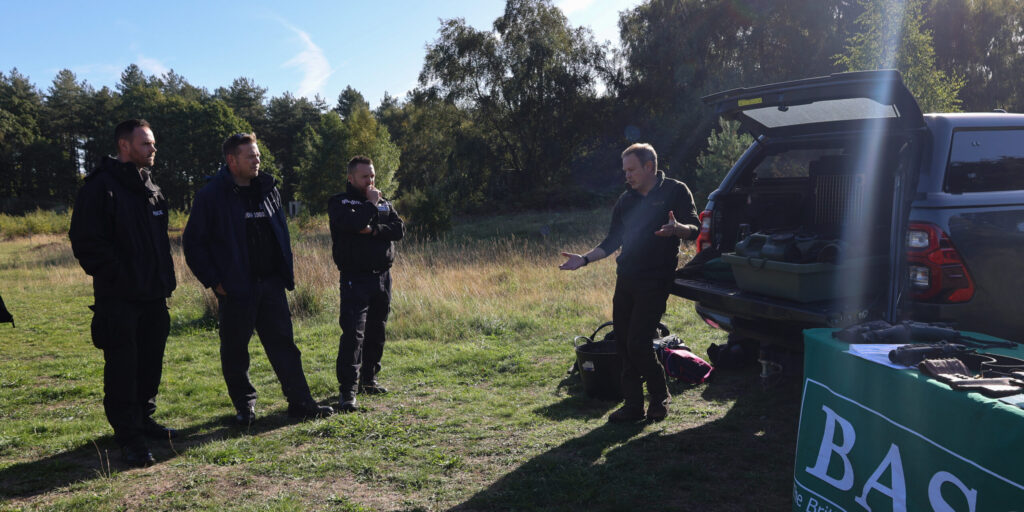
BASC advised Nottinghamshire Police officers on firearms law and legal deer stalking during anti-poaching training on the Thoresby Estate.

BASC has told the AERA Committee that the Hunting with Dogs Bill is unworkable due to its implications for firearms holders, dog owners and landowners.