




Home » Wildfowling » Wildfowling advice » Wildfowling in Scotland
Wildfowling in Scotland
Law, access and sustainability
Wildfowling is one of the oldest and most challenging shooting sports in the British Isles. In Scotland, the sport is deeply rooted in heritage and is guided by a commitment to conservation and sustainable practice. This page provides an essential overview of the unique legal landscape, access rights and expected standards required for wildfowling in Scotland.
The right to recreation and access
The legal framework for wildfowling in Scotland differs significantly from that in England and Wales. Foreshore in Scotland is defined as the area of ground between the high and low water marks of ordinary spring tides. The right to recreation on the foreshore is held by the Crown for all to enjoy. Because shooting is deemed a form of recreation, wildfowling can take place on most foreshores except where this right has been modified – such as in harbours, Ministry of Defence (MoD) ground, and certain Nature Reserves.
Under the Land Reform (Scotland) Act 2003, most land and inland water in Scotland can be accessed by the public, provided it is done responsibly. While shooting itself is not covered by these general public access rights and requires landowner permission, carrying a firearm across land is lawful when travelling directly to or from an area where you have permission to shoot, such as the foreshore.
Carrying firearms
Access rights must be exercised in ways that are lawful and reasonable. By definition, this excludes any unlawful or criminal activity. This is also taken to include the carrying of any firearm, except where the person is crossing land or water to immediately access land or water, or return from such, where shooting rights are granted, held or held in trust or by any person authorised to exercise such rights. This means that it is lawful to carry a firearm or shotgun across private land as long as this is being done to access land or water where you have the right to shoot, such as on the foreshore. Note in Scotland only the right to recreation includes wildfowling using a shotgun only.
Find out further information on the Scottish outdoor access code.
For more information in right of way in Scotland, visit this webpage.
Restricted shooting days and seasons
Wildfowl and waders may not be shot on Sundays or on Christmas Day. Those who shoot must ensure they are familiar with the specific open seasons for different species to ensure full compliance with the law.
For further information regarding open seasons and the specific quarry species that can be harvested in Scotland, visit the BASC What Can I Shoot? page.
Sustainable shooting
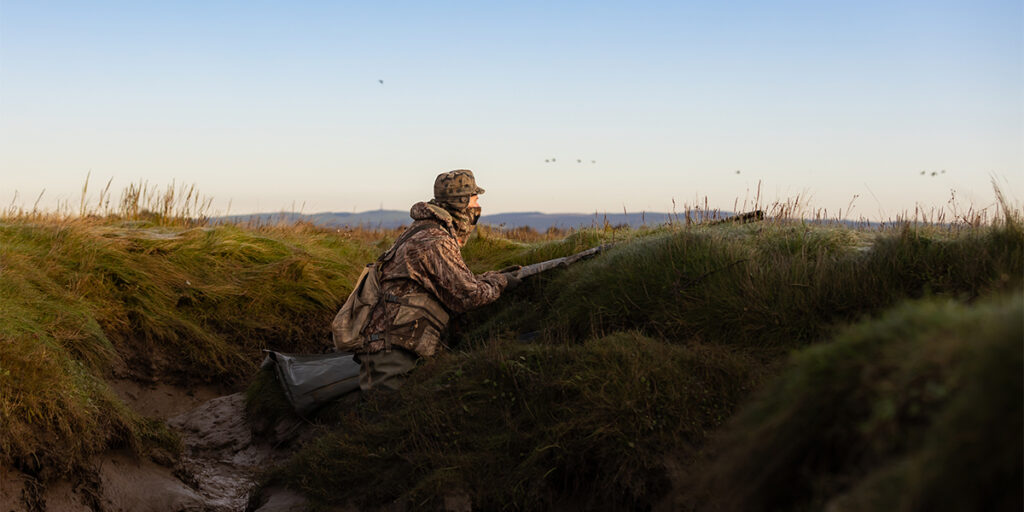
To ensure the long-term future of the sport, wildfowl shooting must be sustainable, respecting quarry species and seeking to conserve the coastal environment. Sustainable shooting is defined as shooting that avoids excessive consumption, complies with the law, and provides food and economic benefits to the community.
Species-specific bag recommendations
Those who shoot must show restraint at all times, following the principle of ’take what you need, not what you can’. BASC recommends the following daily maximum harvest limits per person to ensure healthy populations:
- Ducks: No more than ten ducks per person, per day.
- Specific duck limits: Pochard – no take – targeted conservation effort required. Pintail – take a maximum of two birds per day – targeted conservation effort required. Goldeneye – delay shooting until October where resident goldeneye are present.
- Grey geese: No more than six grey geese in total per person, per day.
- Specific goose limits: Within the total of six, there is a maximum of five pink-footed geese, four greylag geese, and two European white-fronted geese.
- Waders specific limits: Woodcock – delay shooting until late November where resident woodcock are present. Common snipe – delay shooting until 1 September where resident snipe are present.
These recommendations apply unless shooting is conducted under a specific licence agreement or management plan for conservation, health and safety, or crop protection.
For further information on these standards, visit the BASC Sustainable Shooting Code of Practice page.
Data collection and citizen science
Understanding the potential impacts of shooting is essential to managing species sustainably. Where not already required by law or lease, shooters should collect bag data and submit information for all wildfowl species to national monitoring schemes. Wildfowlers are also encouraged to assist with bird counts, ring recovery reporting, wing surveys, and disease monitoring to help protect the species they hunt.
For further information on how to contribute to conservation data, visit the Conservation in Action – BASC
Lead shot restrictions
Restrictions on the use of lead shot for wildfowling in Scotland operate differently from England and Wales and prohibit the use of lead shot over the foreshore, or for shooting over wetlands including streams, rivers, ponds, marshes, wet fields and moorlands with visible standing water. There are some exceptions, mainly over peat-based habitats and short-lived wet areas.
For further information on non-lead alternatives and advice, visit the BASC webpage.
Shooting opportunities
Wildfowling opportunities in Scotland are supported by a variety of permit schemes and BASC-affiliated clubs. Many key areas of the Scottish coast are managed through local authority or government schemes, such as the Eden Estuary, Montrose Basin and Caerlaverock National Nature Reserve. These schemes require specific applications and adherence to local byelaws.
The primary tool for locating clubs and managed sites across Scotland is the BASC Interactive Wildfowling Map. For more detailed information on permit costs, contact details for local secretaries and application procedures, members should consult the BASC Permits and Handbook.
For further information on wildfowling, advice, joining a club or accessing other information, please visit here.
Share
Shooting agreements and consents
Read about shooting agreements, permissions and consents, including links to download template documents.
Tail docking in Scotland
The procedure must be undertaken by a veterinary surgeon on pups aged five days or less.
Biosecurity guidance for wildfowlers
This guidance applies to all wildfowlers, including members, guests, guides, and anyone moving equipment into or between wildfowling areas.