
The most important thing you can do this month
The government’s review of game shooting closes on 1 November. One email is all it takes. If you haven’t sent yours yet, today is the day to act, says Conor O’Gorman.


Get information on the legal shooting season for mammals and birds in the UK.

Apply for funding for your project or make a donation today

Comprehensive information and advice from our specialist firearms team.

Everything you need to know about shotgun, rifle and airgun ammunition.


Find our up-to-date information, advice and links to government resources.

Everything you need to know on firearms law and licensing.

All the latest news and advice on general licences and how they affect you.


We know that game cover crops are full of wildlife, but how can you prove it? BASC’s Ian Danby shares some ideas on how to evidence the biodiversity on your shoot.
Most shoots will keep a record of what game cover crops went in, and where, for future reference. Few however will record the wider wildlife that benefit from those habitats.
Having data on the wildlife assisted by cover crops is not only interesting, but can transform the way you can communicate that value to others.
Trail cams are affordable and can give a good indication of the mammals that are using an area. But what about other groups that thrive in and around game covers, like insects and birds?
The good news is that you don’t need much resource other than time to collect high quality data, but you do need to know how to do it in a repeatable way. This allows you to see change over time and between years. Below are some options on how to get that information.
You pick a location where you have good visibility over the cover crop area and note down the species of bird you see or hear and the maximum number you see at any one point.
You record for a set time, say 30 minutes. If you do this monthly from the same spot, for the same amount of time, you’ll get a comparable set of records for what species use the area and how many.
A very similar method is used by the GWCT for their Big Farmland Bird Count which happens every February. You can get details about that and helpful identification resources at https://www.bfbc.org.uk/.
Timed transect surveys for birds
The British Trust for Ornithology use this as the basis for structured surveys like Breeding Bird Surveys and a simplified version is used to enable people to record the birds they see and hear on a standard walking route too.
The idea is simple enough, you walk a route and record how long it took and then, like above, what birds you see or hear and the maximum number you see at any point. As a rough guide you should aim to cover 1km in about 45 minutes. So, if your route is 500m then just over 20 minutes is about the right amount of time to spend recording. The BTO Bird Track website and app tools could be used to both keep and share your records.
For both methods, a good time is an hour or more after dawn to about mid-morning. At dawn many birds are getting themselves to where they want to spend the day and from late morning they are settling down for a rest.
You could also try the Merlin Bird ID app while out and about, especially along woodland edges. You will be amazed at the diversity of birds it picks up from your mobile phone microphone. It is very good and does warn you if a species is unlikely at that location and time of year.
However, I recommend you treat it as a suggested list of birds that you should verify yourself – can you hear the song it detected and can you actually get a visual on it to confirm the suggestion?
There are always one or more species of butterfly on the wing between April and October. Some species like red admiral or comma can be seen in all those months while others, typically rarer species, might only be flying for a few weeks – like some fritillary or hairstreaks.
The charity Butterfly Conservation runs the Big Butterfly Count in July each year as it cuts across the largest number of species’ flight times. However, you can use their survey method at any time between April and October.
All you need to do is pick a likely spot in your game covers, sit there for 15 mins and record what species you see and the maximum number of each species seen at any one point. A pair of binoculars are a good companion for butterfly spotting to save your shadow falling on them when you are trying to get a better view.
Understanding the range of species and number in your cover crops or other areas gives you an understanding of the food that is available for chicks, fledglings and other wildlife in the critical spring and summer months. It is also astonishing how many species you will discover.
General invertebrate sampling using a sweep net
Sweep nets can be made or bought but they do need to be sturdy to withstand smashing through the vegetation. There is no national ‘standard’ methodology for sweep netting like there is for birds to enable comparison with much bigger datasets. The most important thing is you do the same thing each time so you can get a true comparison between your samples.
If you want a suggestion then consider walking through about 20m of cover crop in a W-shape, so you touch edge and central sections of the cover, for about two to three minutes. Then have a look what you have got in the net. Identifying insects to species level is complicated and gets experts arguing, so keep it simple. Keep it to major groups initially like snails, beetles, flies etc but do make a guestimate of how much life you have.
Taking photos can be a useful way to compare and communicate the abundance of life the cover crop is supporting. Use the Google Lens tool to help identify what species you have in your photos.
The Royal Entomological Society and Buglife are two the main charities for invertebrates. Buglife have some accessible resources for identifying bugs and pollinators that are useful.
GWCT has used sweep net sampling in the studies for decades. They also produced a guide called Chick Food Favourites showing the top eight insects favoured by farmland birds.
Let us know how you are getting on and we’d be delighted share your story.
This article is part of our Four Seasons campaign. The campaign showcases and celebrates the real value shooting delivers for people and the environment.


The government’s review of game shooting closes on 1 November. One email is all it takes. If you haven’t sent yours yet, today is the day to act, says Conor O’Gorman.

Defra has rejected BASC’s request for more time to respond to its call for evidence on game shooting, leaving participants fewer than three weeks to make their voices heard.
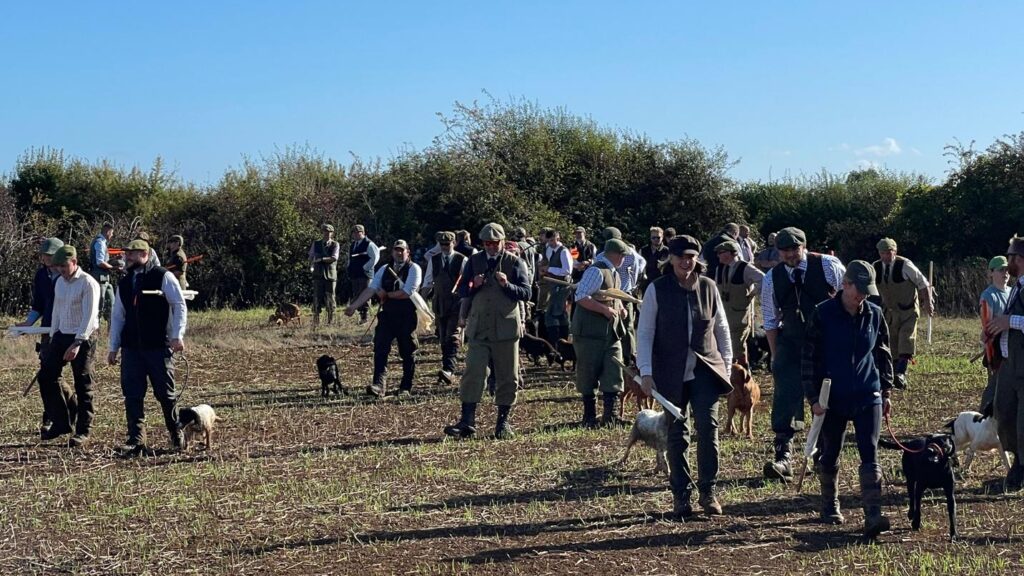
BASC’s Sam Walker joins the beaters at Ponsonby Farms in Gloucestershire to see a wild grey partridge recovery, built on shoot management, in action.