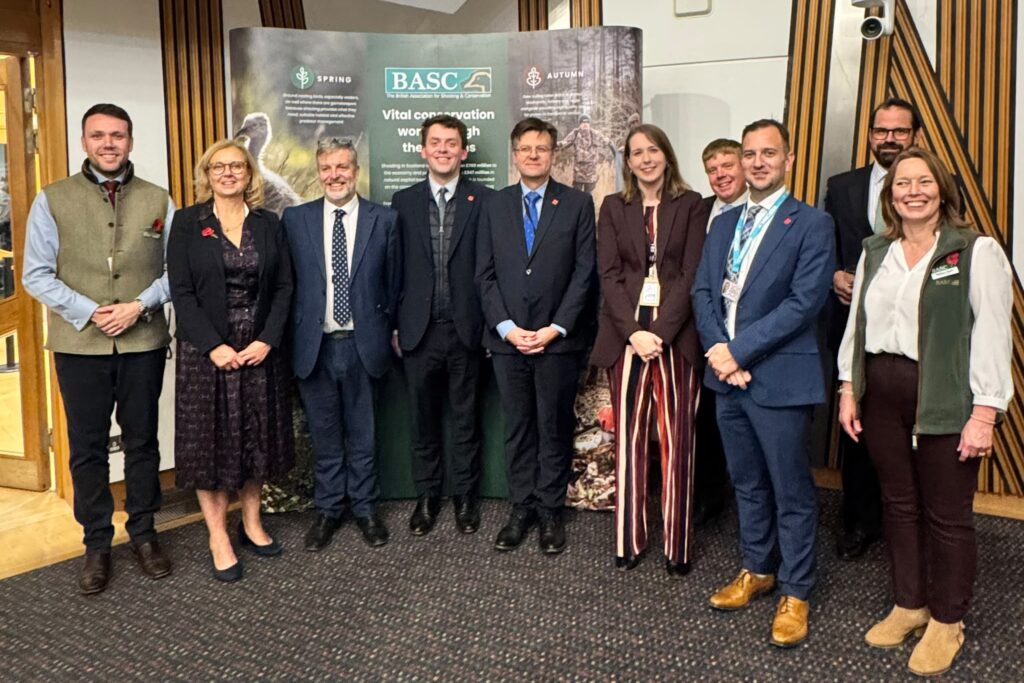
BASC champions Scotland’s wild larder at Holyrood reception
BASC Scotland highlighted the value of wild game and venison to Scotland’s food culture, rural economy and environment at a Holyrood reception for Great British Game Week.


Get information on the legal shooting season for mammals and birds in the UK.

Apply for funding for your project or make a donation today

Comprehensive information and advice from our specialist firearms team.

Everything you need to know about shotgun, rifle and airgun ammunition.


Find our up-to-date information, advice and links to government resources.

Everything you need to know on firearms law and licensing.

All the latest news and advice on general licences and how they affect you.

BASC Scotland is calling for a review into the Scottish Outdoor Access Code, following concerns it falls short for shooting and conservation.
In a recent membership survey of almost 500 BASC members in Scotland, ranging from gamekeepers to deer stalkers, there was an overall dissatisfaction with the current provisions surrounding outdoor access.
Outdoor access rights allow public access to most land and inland water in Scotland, as long as it is done responsibly, according to the terms of the Outdoor Access Code.
The survey’s findings will feed directly into the Scottish Parliament’s Rural Affairs and Islands Committee call for views, which in turn will inform the committee’s inquiry into Scotland’s outdoor access system.
Of the 468 BASC members who responded to the survey, 62 per cent said that the level of public access had increased in the past five years, marking a change since the Covid-19 pandemic, with an increasing recreational pressure affecting deer and game management.
Responsible access remains a significant challenge across Scotland, especially for deer managers. Many respondents cited examples of where clear signage was ignored during periods of management, causing issues for deer stalkers and managers trying to achieve annual cull targets.
In a lowland context, respondents reported that increased public access was disrupting deer management by disturbing deer and undermining planned stalking. This was a particularly by walkers by walkers unexpectedly entering stalking grounds at dawn and dusk.
On game management and conservation, gamekeepers highlighted the impact of dogs not being on a lead, citing examples of ground nesting birds being disturbed on farmland and grouse moors.
Forty-five percent of respondents identified wildlife and deer disturbance as a problem associated with irresponsible access, and 36 per cent identified gamebird disturbance.
Uncontrolled dogs, litter and the worrying of livestock and wildlife were the most frequently reported problems.
More respondents believed the access system was working poorly rather than well. There was a particularly negative perception of the effectiveness of access authorities, where 67 per cent of those answering the survey considered access authorities to be ‘ineffective’.
Wildfowling members stated that the code addressed their needs – particularly where foreshore access is required – however they also cited examples of where other outdoor users, such as paddleboarders and wild swimmers, hinder wildfowling.
BASC Scotland is now calling for a review of the code, alongside a renewed focus on educating the public about its detail, calling for a greater emphasis on clear communication, improved support and accountability, effective enforcement and greater recognition of the practical challenges facing land managers.
BASC Scotland director Peter Clark said: “Scotland’s landscapes are a working environment as well as a place for recreation. Those involved in deer and game management undertake important work that contributes to wildlife management, habitat conservation and the wider rural economy.
“Our survey highlights the very real difficulties that can arise when people walk into areas where stalking or shooting is taking place, allow dogs to roam uncontrolled, or ignore reasonable requests and signage.
“Deer or game management cannot simply be put on hold because people are accessing the countryside. It requires careful planning and, at times, suitable conditions to ensure that operations can be carried out safely and effectively.
“Better education, improved communication and a more practical approach to managing access conflicts would benefit everyone.
“I would like to thank all those members who completed the survey, which will help form our official response to the Scottish Parliament’s call for views. Those working to manage Scotland’s countryside should not be placed in a position where essential activities are compromised or public safety is put at risk.”
BASC Scotland highlighted the value of wild game and venison to Scotland’s food culture, rural economy and environment at a Holyrood reception for Great British Game Week.

Changes to the grouse licensing system in Scotland affect the area a licence applies to, as well as NatureScot’s power to revoke or suspend licences.

The call for evidence on game shooting in England generated more than 26,000 emails to Defra. Conor O’Gorman takes stock and looks at what comes next.